Whiskey Review: Bardstown Distillery Reserve Mars
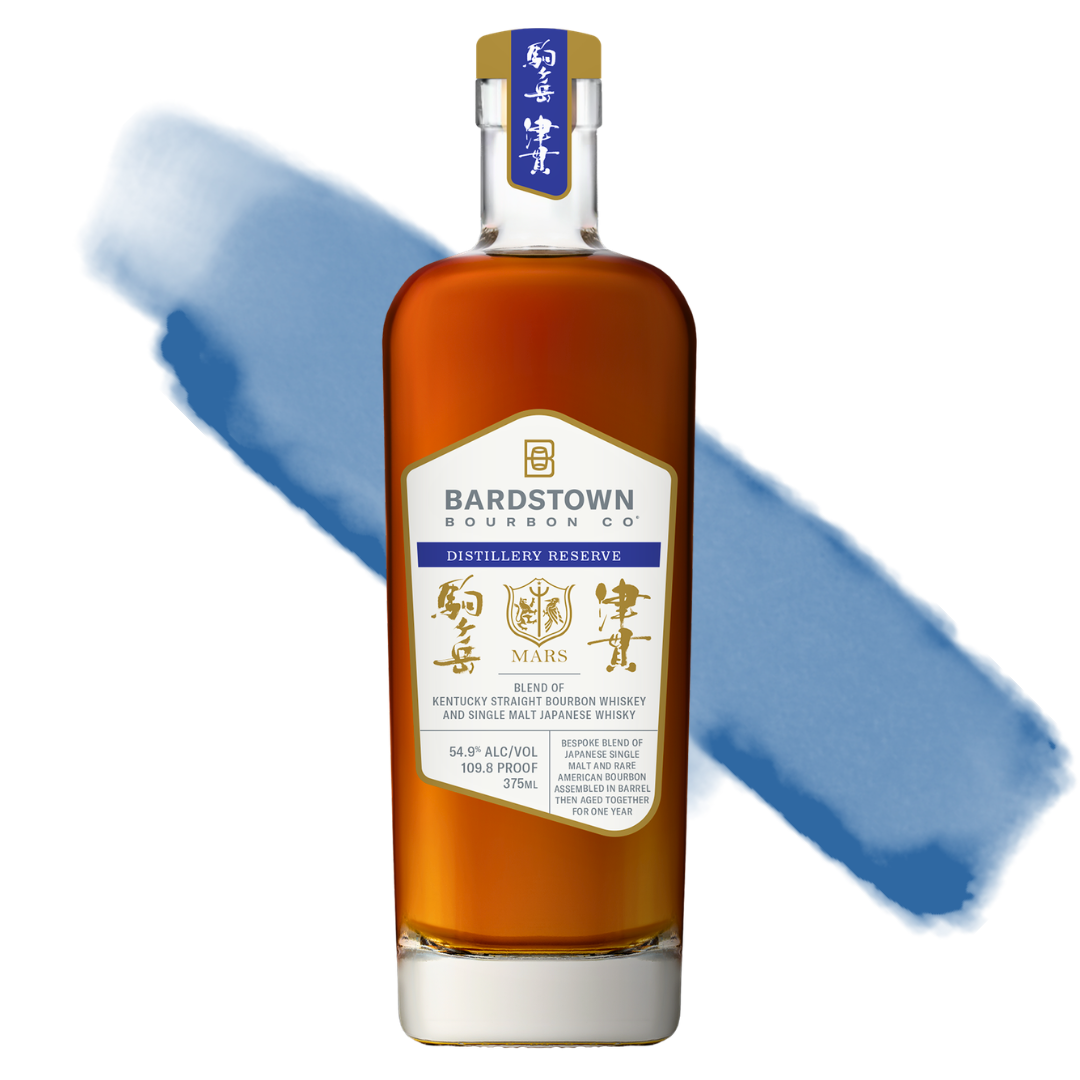
The short answer: Bardstown's Distillery Reserve Mars is a 109.8-proof, $99.99 blend of 10- and 16-year Kentucky bourbon co-aged for one year with 5-year Japanese single malts from Mars Whisky's Komagatake and Tsunuki distilleries, originally aged in Umeshu plum and Sakura cherry wood casks. Bourbon-dominant at 77%. We scored it 45/50, a top contender for whiskey of 2026.
Introduction
Today on Film & Whiskey, we're returning to Bardstown Bourbon Company with another release from their Distillery Reserve line: Mars Single Malt Japanese Whiskey Blend. We've reviewed nearly every Distillery Reserve release Bardstown has put out over the last two years, including Cathedral French Oak, Hokkaido Mizunara Oak, Normandie Calvados, and Cascadia Garryana Oak. The worst score any of them has earned from us still landed around an 8/10 on average. The Cathedral French Oak in particular remains in our personal pantheon of best whiskeys ever reviewed on the show. The bar is high.
What sets Mars apart from the rest of the Distillery Reserve catalog is the technique. Most finished bourbons get a few weeks of barrel rest in a secondary cask before bottling. Bardstown's approach here is co-aging. Master Blender Dan Callaway introduced two Japanese single malts from Mars Distillery (Komagatake in central Honshu and Tsunuki in southern Kagoshima) into barrels of mature Kentucky bourbon, then let everything age together for a full year. The result, per Bardstown, is meant to be true integration rather than a marriage of two distinct spirits.
The blend math is worth understanding before the first sip. The bottle is 77% Kentucky bourbon (69% 10-year and 8% 16-year, both standard high-corn mashbills) and 23% Japanese single malt (20% Komagatake aged in Umeshu plum liqueur barrels, and just 3% Tsunuki aged in rare Sakura cherry wood barrels). The honest question this whiskey has to answer isn't whether it drinks like Japanese whiskey. It doesn't. The question is how much movement those Komagatake plum and Tsunuki cherry casks can produce in a mature, proof-heavy bourbon during 12 months of co-aging in a Kentucky rickhouse.
It clocks in at 109.8 proof, which is the proof point we think Bardstown has settled into for the Distillery Reserve format. Some of their earlier Discovery series releases pushed into the 120s and burned hot. The 107 to 109 range has become their groove. The format is also intentional: 375 mL bottles at $99.99. For a luxury whiskey that you're only going to pour on special occasions, half a bottle is the right amount. Whiskey oxidizes, and most consumers who spring for a $200+ bottle never finish it before it loses what made it special in the first place. Bardstown's 375 mL format respects both the consumer's wallet and the spirit's drinking window. We're fans of the choice.
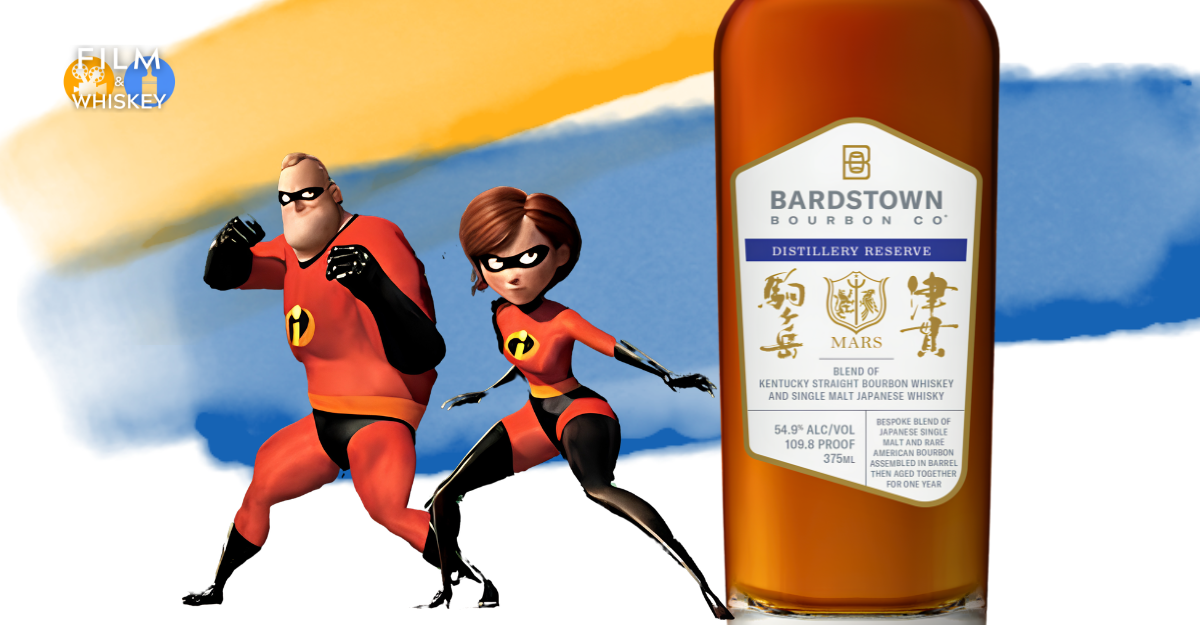
With all that on the table, let's get into it. This review is taken from our episode "The Incredibles (2004) / Bardstown Bourbon Company Distillery Reserve Mars."
Nose
Brad: This Mars is incredible. The nose has great toasted marshmallow. It gets into the world of nuts, not peanutty, more of an almond. There's cherry on this, moving into a nice plum vibe. I'm loving this. It's a delectable nose. I'll give it an 8.5/10.
Bob: There's some type of beer this is reminding me of. I want to say it's like a peanut butter porter. It's got these dark notes somewhere between a peanut butter porter and an Irish red stout. There's something about that caramelized malt and barley that's present here. The two dominant notes for me, you nailed it: cherry and almond. This is like an almond cake with cherries dripped on top, and you're drinking it with a good dark caramely beer. It's probably not the most complex whiskey I've ever nosed, but those three notes are so interesting and so out of the ordinary for what we typically drink that I'm riding high on this one. I'll give it a 9/10 on the nose.
Taste
Brad: The palate is as good as the nose. For me, the dried plum and raisins come through strong. There's a candied almond, taking on a sugary vibe. Underneath all that, it's almost a creamy vanilla pudding that I love. I'm at an 8.5/10 on the palate.
Bob: There's a malt-o-meal note here, like the puffed barley caramely cereals from my childhood. And I get dark stone fruit. It's plummy. What excites me about this: I've been talking nonstop about how lots of the whiskeys we've been trying lately turn bitter on the back end of the palate. There's a lovely caramelized barley note underneath this that keeps it sweet throughout the entire experience. I don't know that this is incredibly complex, but it's decadent. I'm at a 9/10 on the palate.
Finish
Brad: When you get to the finish, it gets better. It dives into baking spices. For me, the caramel finally hits about a minute after I drank it. The marshmallow is there in spades. It gets a ton of black pepper on top of all that. I'll give it a 9/10 on the finish.
Bob: The two Japanese malts that were shipped over to Bardstown: one was finished in Sakura wood, which is apparently a tricky and finicky wood to finish in, and the other was finished in plum liqueur barrels. That's where we're getting that plumminess from. On the finish is where it tips in to the sometimes-bitter barley flavor we get on some scotches and Japanese whiskies, and you get a touch of char ashiness. It's the least sweet part of the experience for me, but it's long-lasting, mouth-watering, and carries a hint of sweetness. I'll come down to an 8.5/10 on the finish, but it's still phenomenal.
Balance
Bob: This is the second-best Distillery Reserve they've done behind the Cathedral French Oak, and that's in my pantheon of whiskeys we've ever had on the show. I'll give it a 9/10 on balance.
Brad: I'll give it a 10/10 on balance. This is not the most insanely complex thing we've ever had, but it's complex enough, and all the flavors within that complex wheelhouse work incredibly well together. I love this whiskey.
Value
Bob: On value, I can't decide between a 9 or a 10. It's only $100, and you're only getting 375 mL. The problem is they call this the Distillery Reserve because you can only get it at the distillery, or maybe some select online retailers. Every one of these has sold out. Then you have to pay markup on it. At $100, this is a 10. I'll split the difference at 9.5/10 overall because it's been out for a couple of months and I don't know what the availability looks like right now.
Brad: At $100, for what we'll call a $200 bottle of luxury whiskey you can get for $100, I'll give it a 9/10. This is an excellent value for luxury whiskey, especially because you only have to spend $100 for a half bottle that you're not going to waste. It's not going to go bad sitting on the shelf.
Final Scores
Bob: My final score is a 45/50. I know what a 90-out-of-100 whiskey tastes like, and this is that.
Brad: If we were giving medals, this is a double gold, no questions asked. I'm also at a 45/50.
Conclusion
We're coming out to a combined score of 45/50 (or 90/100), which puts Bardstown's Distillery Reserve Mars firmly in excellent territory. For reference, 35/50 is where we'd typically recommend trying a pour at a bar or buying a bottle, 40/50 is great, and 45/50 is excellent. Both of us hitting the 45 mark on the same whiskey is rare, happening on fewer than 5% of the bottles we review. Bardstown, hear us when we say this is the best whiskey we've had in 2026, and it's going to be very hard to beat for whiskey of the year. If you can make it to Bardstown's distillery gift shop in Kentucky or their Tasting Room in Louisville, this is one to pour an inch of just to see how the math works out in the glass.
Frequently Asked Questions
Is Bardstown Mars Distillery Reserve worth the price?
Yes. At $99.99 for a 375 mL bottle, you're paying roughly half-bottle pricing for what tastes like ultra-premium whiskey. We scored it 9.25/10 on value combined. The 375 mL format respects both the consumer's wallet and the drinking window of a special-occasion bottle that you don't want to oxidize before you finish it.
What does Bardstown Mars Distillery Reserve taste like?
Toasted marshmallow, almond, and cherry on the nose, with notes of a dark caramely beer underneath. The palate is plummy and decadent with caramelized barley sweetness and creamy vanilla pudding. The finish brings baking spices, caramel, marshmallow, and black pepper. Bourbon dominates at 77%, with Japanese single malt contributing plum and cherry character.
How is Bardstown Mars Distillery Reserve made?
Bardstown co-aged Japanese single malts from Mars Distillery's Komagatake (previously aged in Umeshu plum liqueur casks) and Tsunuki (previously aged in Sakura cherry wood casks) locations with 10- and 16-year Kentucky bourbon for one full year in shared barrels. The final blend is 77% bourbon, 23% Japanese single malt, bottled at 109.8 proof in 375 mL format.

Host
Bob grew up watching movies of all kinds, mostly with his dad. In high school, he became a fully-fledged film nerd, making and watching films regularly. He's since cooled it on his dreams to be Spielberg, and instead loves to teach about and discuss film with anyone who will listen.
Whiskey Review: Clyde May’s Alabama Style Whiskey