Whiskey Review: Penelope Riviera

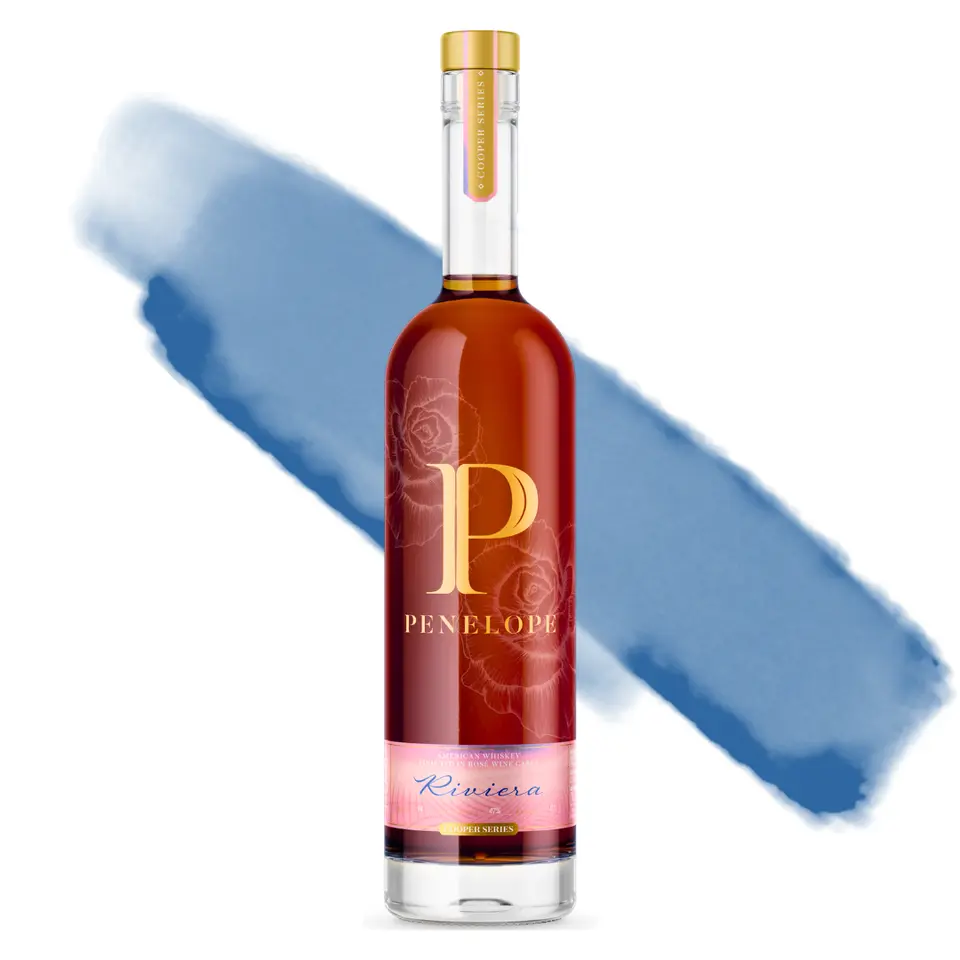
The short answer: Penelope Riviera is a 94-proof blend of 8-year American light whiskey and straight bourbon, finished in rosé wine casks from Southern France. MSRP is $79.99. It's a pleasant, springtime-friendly sipper with rum-like sweetness and bright citrus, but the price outpaces the juice. We scored it 33/50.
Introduction
Today on Film & Whiskey, we're returning to Penelope, a brand we haven't touched in a while but have a strong history with. Today's release is Riviera, a blend of 8-year American light whiskey and straight bourbon, finished in rosé wine casks from Southern France, bottled at 94 proof and priced at $79.99 in Ohio.
Two things worth flagging before we get into it. First, we've had the Penelope Rosé Finish before, and it remains one of our favorite expressions from the brand, so we came into this with high expectations for anything finished in rosé from Penelope. Second, American light whiskey is a category we've only touched on once before, and it plays by a different set of rules than bourbon or rye, closer to corn whiskey in some ways.
American light whiskey was developed as a response to the growing trend through the 1960s of consumers moving away from brown liquors toward vodka. Back in season three, we reviewed Seagram's 7, which took one route: cutting whiskey with neutral grain spirits, essentially vodka, and hoping vodka drinkers would come along for the ride. The other route was light whiskey, which is made the same way as whiskey but distilled to a much higher proof point, in the 160 to 190 range. That strips out most of the grain character, and the resulting spirit is then aged in used barrels so it doesn't pick up the harsh tannins of new oak. It's aged much longer, similar to corn whiskey, and the result tastes like a well-matured whiskey made through a completely different process.
Riviera pairs 8-year American light whiskey with an undisclosed straight bourbon. Straight bourbon has to be at least 2 years old, so the actual balance of the whiskey may skew younger than the 8-year age statement on the label suggests. Let's see how the rosé finish ties everything together.
This review is taken from our episode "West Side Story (2021) / Penelope Riviera." Click the link to listen to this review in audio format.
Nose
Brad: The nose had a ton of floralness. It lacked the tang of a traditional peach, closer to a white peach. There were table grapes and some citrusy orange peel vibes. It's a pleasant nose, but not one that makes me super excited. I'll give it a 7/10.
Bob: I share a lot of your notes. With light whiskey, we've been finding it more popular in the market. During the whiskey boom, when producers could sell anything, they were like, "Let's do light whiskey." Now we're getting 15- and 18-year aged light whiskey being released, and that stuff is phenomenal. Eight-year light whiskey is nothing to sneeze at, but because it doesn't pick up as much wood character as a new charred barrel would, it takes longer to mature. They're also blending this with straight bourbon, and the label doesn't say how old, so possibly as young as 2 years. This smells youthful to me. What's masking that are the citrusy, bright notes: lemon peel, orange zest, all keeping it in a bright, floral headspace. I wonder if the youthful sense on the nose is going to creep into the taste. I'll give it a 7.5/10.
Taste
Brad: The palate reminded me of rum. It has a cane sugar vibe going on. There's vanilla bean, and that white peach sticks around. It's got a soft peachy tone without the tanginess. It's a pleasant whiskey, and there's nothing that makes me get out of my chair and get excited, but it's a solid experience to drink. I'll come up to a 7.5/10.
Bob: I'll give it a 7/10. There is a lot of rum character to it. Even with an aged rum, a 3- or 4-year aged rum stays in that simplistic sugar note, and this has that. Part of the reason producers use light whiskey is because it's supposed to be softer and not carry tannic flavors. But this has a toasted barrel char ashiness coupled with a black tea tannic quality. If they were trying to avoid that, it's definitely here. I don't think it's a bad whiskey, though.
Finish
Brad: The tea notes are where I was going on the finish. It's almost like you took a peach tea and added legitimate black tea to it, and you get a bitterness on the back end. The vanilla turns into vanilla protein powder more than fresh vanilla. The orangey-ness turns into orange rind on the back end. I don't dislike the finish, but it drops off for me. I'll give it a 6.5/10.
Bob: I don't think it's a mistake that they released this in the spring. This is a springtime floral, summer sipper. It's 94 proof, which is a perfect proof point if you want to mix it with something. Throw this into an iced peach tea in the summer and you've got a porch sipper. We're drinking it neat, so everything I got on the palate is sticking around on the finish. I don't know if they used charred or uncharred used barrels for the light whiskey, but there's a tannic char note going on in the back of my palate. The vanilla is there but doesn't overwhelm anything, and the orange becomes more of an orange pith than orange zest. I'll give it a 7/10 on the finish.
Balance
Bob: I'll give it a 7.5/10 on balance. It's a perfect three-out-of-four-star whiskey for me.
Brad: I don't think there's enough complexity here for me to give it over a seven or even at a seven. I'll give it a 6.5/10. It's relatively well-balanced. Nothing comes out of left field, but there's nothing about the experience I'm passionate about.
Value
Brad: In the illustrious state of Ohio, this will set you back $79.99. That for me is the breaking point on this. I feel like it's a $45 to $50 quality and it's costing you $80 to $87 with tax. I'll give it a 4.5/10 on value.
Bob: I'll go 5/10 on value. This is for a Penelope completist. If this is your brand, try it out. We love Penelope, and the regular Penelope Rosé is leagues better than this one, largely because of the sweet notes of the bourbon underneath. Is this a fun summertime mixer? Absolutely. But I don't know that I'd ever recommend paying $80 for it.
Final Scores
Bob: My final score is 34/50. If we're just talking about the juice, this gets a hesitant thumbs up. The price point is the biggest detractor.
Brad: I'm at 32/50. The $80 is a deal breaker for me.
Conclusion
We're coming out to a combined score of 33/50 (or 66/100), which puts us just shy of the 35/50 mark where we'd typically start recommending you seek out a pour at a bar or pick up a bottle. For reference, 40/50 is great territory and 45/50 is excellent. Penelope Riviera isn't a bad whiskey. It's a pleasant, springtime-friendly sipper with rum-like sweetness and bright citrus, and at 94 proof it would make a good iced peach tea mixer on the porch. But $80 asks more of this bottle than the juice can deliver. If you spot it at a bar or on a friend's shelf, it's worth a try. If you're set on spending $80 on Penelope, though, the standard Rosé Finish remains the better play.
Frequently Asked Questions
Is Penelope Riviera worth the price?
No. At $79.99 in Ohio, we scored it 4.75/10 on value combined. Both of us feel it drinks like a $45 to $50 bottle. The rosé finish is pleasant and the profile is summer-friendly, but the underlying blend of 8-year American light whiskey and unspecified straight bourbon doesn't justify the ultra-premium price tag.
What does Penelope Riviera taste like?
The nose brings white peach, table grapes, orange peel, and a floral character. The palate is rum-like with cane sugar, vanilla bean, and lingering white peach. The finish evolves into peach tea with black tea bitterness, vanilla protein powder, and orange rind. Overall, a bright, springtime profile with a tannic edge on the finish.
How does Penelope Riviera compare to Penelope Rosé Finish?
Penelope Rosé Finish, the brand's original rosé-cask-finished bourbon, is a more compelling expression for the same finishing technique. The Rosé Finish uses a straight bourbon base, which gives it richer sweetness and better integration with the rosé casks. Riviera swaps most of the bourbon for American light whiskey, which drinks lighter but loses depth.

Host
Bob grew up watching movies of all kinds, mostly with his dad. In high school, he became a fully-fledged film nerd, making and watching films regularly. He's since cooled it on his dreams to be Spielberg, and instead loves to teach about and discuss film with anyone who will listen.
Whiskey Review: Bardstown Bourbon Company Victoria Pineapple Finish