Movie Review: The Odyssey (2026) & Nolan's Own Odysseus-Sized Gamble
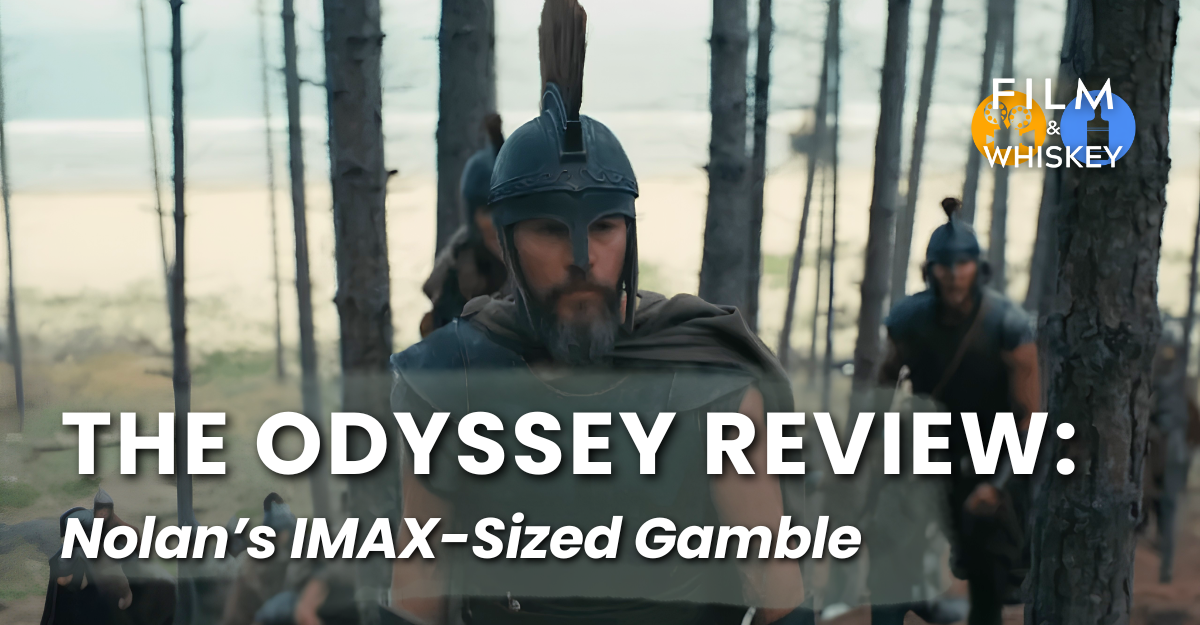
In short: Christopher Nolan's Homerian IMAX epic spends an hour disproving its own format, then wins back trust with real ambition and wonder. 7.5/10.
In review: Shot entirely on IMAX cameras across six countries, and as its director will tell you, without a single green screen, Christopher Nolan’s The Odyssey wants you to feel its scale in every frame. As it turns out, Nolan’s dogged commitment to the high-risk, high-reward IMAX format may be a perfect shared metaphor for Odysseus’ folly.
It’s strange to begin a review talking about lenses, camera setups, and film stock. But so much of The Odyssey’s marketing and junkets have revolved around the use of the bulky, expensive IMAX that it’s worth noting the format nearly sinks the film for a dreadful first hour. Nolan’s propulsive editing style and scripting run headlong into the format's actual physical limitations, namely a much-publicized challenge in filming dialogue scenes. Scene after scene in the exposition-heavy first act resolves into shot-reverse-shot, sometimes not even generous enough to qualify as over-the-shoulder. At one point the coverage is so severed you'd swear the actors were never on set together, as actors talk to their off-screen counterparts in cobbled-together scenes that resemble a COVID-shoot economy dressed up in seventy-millimeter clothing.
Part of the sluggishness in the early going is the decision to give the film over to Tom Holland’s Telemachus as he searches for answers about Odysseus’ whereabouts. Holland is game in the role, but the prince of Ithaca doesn’t have much to do (that’s kind of the point of the story) and camping in Ithaca’s holding pattern prevents the movie from gaining any momentum.
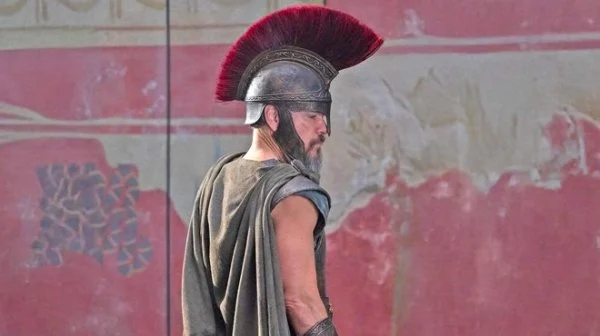
Luckily, the struggles of the first act don’t ultimately sink this voyage. As with Oppenheimer, there’s a pretty clear three-act structure here, and Act Two kicks off with Menelaus (Jon Bernthal) recounting the storming of Troy in what turns out to be a thrilling sequence. From there, Odysseus’ travels become the main focus, and as the story gets weirder, the filmmaking gets tighter and the visuals more compelling. The sequence in Hades is perhaps the most gorgeously-rendered in the film, full of black sand and soot and conversations with the dead.
The Circe sequence, anchored by Samantha Morton, earns its reputation the hard way, with body horror more grisly and more unexpected than anything Nolan has put on screen. The flashback to the fall of Troy, the actual sack of the city, is the most purely emotional stretch in the movie. The final battle holds up too.
But for each sequence Nolan commands, he gives us one that doesn’t come together: the Polyphemus sequence, cyclops and all, just doesn't work, and neither does the Laestrygonian ambush—Homer's unarmored cannibal giants reimagined here as an armored war-party.
Despite a stellar cast of actors, all of whom turn in solid work, nobody in The Odyssey delivers a performance that screams “Oscar” the way Cillian Murphy did in Oppenheimer. This is a movie where the setting, and the filmmaking itself are the stars. Hathaway comes closest to a standout, and John Leguizamo, as the loyal swineherd Eumaeus, deserves to be part of year-end award conversation too. Robert Pattinson, playing the suitor Antinous, chews scenery to the point of tipping over, entertaining but a little much.
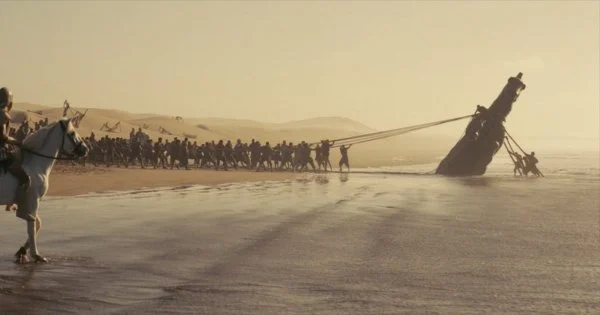
For a film that ultimately rescues itself from ruin, there are several core Nolan-related issues at its heart, not least of which that he still hasn't learned to architect a real action sequence from the blocking up; he's a director who builds his set pieces in the edit, and it shows whenever the fighting has to carry a scene by itself. The notable exception here is the sacking of Troy, and I suppose if Nolan is going to get it right anywhere, that’s the place to do it.
Then there’s Nolan the philosopher and sociologist, who bludgeons us with the core themes: too many ideas competing to be the spine of the film, or maybe a refusal to settle on one because he wants every card revealed exactly on schedule. The clearest thread running through The Odyssey is the tension between Zeus’ Law—treating others as you'd want to be treated, since the stranger at your door might be a god in disguise—and the belief that the gods help those who help themselves, and what happens to a society that forgets the first rule. Odysseus’ folly is not that he defied the gods, but that he broke the fundamental Humanist law in his deception of the Trojans. The betrayal built into the Trojan Horse, here a catalyst for societal catastrophe, a pattern humanity seems doomed to repeat, gets underlined about eighteen times in red marker. It’s a logical extension of his Oppenheimer message, with essentially a beat-for-beat recreation of that film’s ending.
Nolan understands the humanist core of the film and its resounding personal tragedy. It’s easy to see what attracted him to the material, and also easy to see why he’s so attached to the characters in Ithaca in the early stretches: the townspeople essentially held hostage while they wait to learn whether Odysseus is alive plays like a miniature Dunkirk. It's also the least interesting stretch of the film.
What's missing, and what this material needs, is the ability to make an audience believe in a world where ghosts and cyclopes and witches are simply real. Nolan, for all his strengths, has built a career on being the director to de-fantasize a world. His Batman was famously “grounded” and “gritty,” swapping the camp of Joel Schumacher for paramilitary tactical gear. Even his film about magic, The Prestige, is constructed so as to demythologize the magic trick, to ground it in the reality behind the illusion, and to offer the explanation for the trick as a kicker. Hell, even Inception, the movie where he has the most fun with fantasy world-building, is so beholden to the “rules” that it leaves many viewers cold. Homer’s epic may not exist in a “magical realist” world in the strictest sense of the term, but this material at its core is better suited to a Del Toro, a Cuarón, maybe a Peter Jackson, someone who trusts wonder enough to stop explaining it.
Somehow, against a rough first hour that had this thing tracking toward a 4/10, The Odyssey rescues itself. Call it a 7.5/10. B-tier Nolan, actively bad for a stretch, and then, once it stops trying to ground what was never meant to be grounded, it moves you.

Host
Bob grew up watching movies of all kinds, mostly with his dad. In high school, he became a fully-fledged film nerd, making and watching films regularly. He's since cooled it on his dreams to be Spielberg, and instead loves to teach about and discuss film with anyone who will listen.
Whiskey Review: Clyde May’s Alabama Style Whiskey