SHANG East + West Kentucky Blend Review: A $46 Baijiu-Whiskey Experiment?
Updated: August 2026
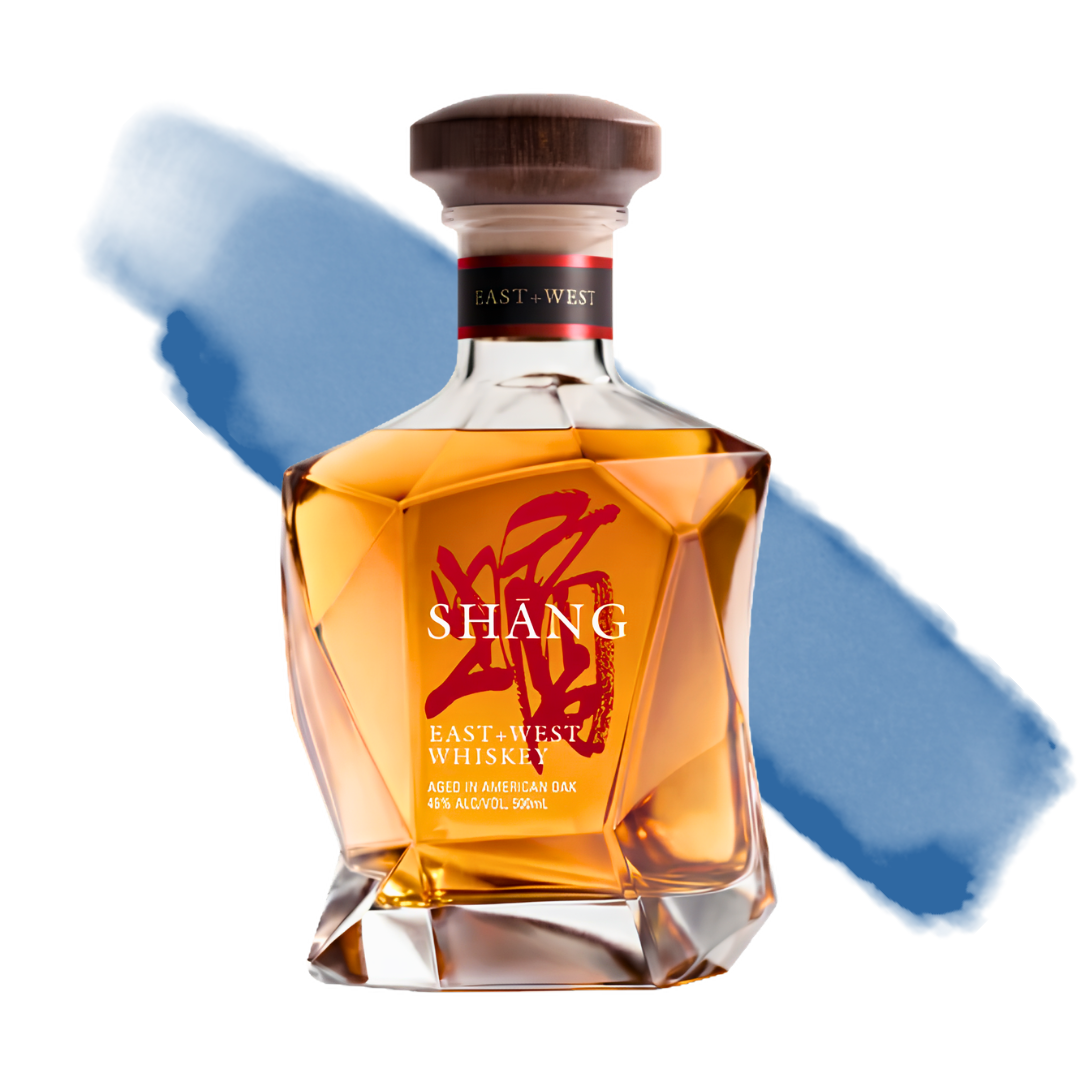
The short answer: SHĀNG East + West Kentucky Blend is a 92-proof (46% ABV) blend of SHĀNG's jiàngxiāng whiskey (a sauce-aroma baijiu from China's Chìshuǐ River basin, redistilled and aged in American oak) with a proprietary red sorghum whiskey distilled at Whiskey House of Kentucky. SRP is $45.99 for 500 mL. It's an accessible entry into a new cross-cultural category, but the profile lands unevenly. We scored it 28.75/50.
Introduction
Today on Film & Whiskey, we're reviewing the second of two SHĀNG whiskey samples we received. Last week we reviewed SHĀNG Dàn Yǎ, the brand's first expression, which is built on jiàngxiāng whiskey (a Chinese sauce-aroma baijiu that has been redistilled and matured in charred American oak). Today's release, SHĀNG East + West Kentucky Blend, takes that same jiàngxiāng whiskey foundation and marries it with a proprietary American red sorghum whiskey distilled at Whiskey House of Kentucky, then ages the blend in charred American oak. Red sorghum is the through-line grain for both expressions in this lineup, bridging a Chinese sorghum tradition with an American one under a single label.
East + West comes in at an SRP of $45.99 for a 500 mL bottle, roughly $19 below its sibling Dàn Yǎ ($64.99 for 500 mL), and is bottled at 92 proof (46% ABV). SHĀNG is produced by Maritine Brands, a joint venture between True Essence Foods and Guìzhōu Guótái Shùzhì Liquor Group, in partnership with Whiskey House of Kentucky and The Blending House. The category the brand is proposing to create is called "jiàngxiāng whiskey," which the producers describe as sauce-aroma baijiu refined through American whiskey craftsmanship.
Brad and I disagreed pretty famously on last week's Dàn Yǎ, with Brad scoring it 19/50, one of his lowest scores of all time. So the stakes going into East + West are clear: does folding in an American red sorghum whiskey make this a more approachable version of the concept, or does it dilute what makes SHĀNG interesting in the first place?
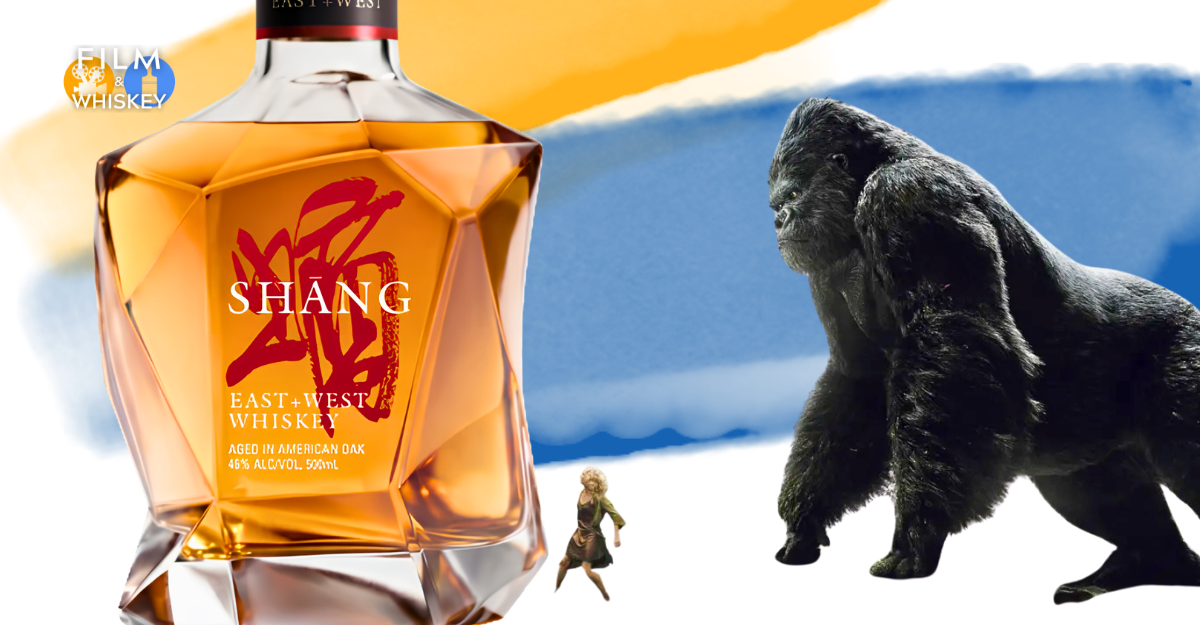
A quick note on the name. SHĀNG uses a macron (the horizontal line over the "a"), which formally signals the vowel should be pronounced as a long A, closer to "shahng" than "shang." Bob prefers "Shang" because it rhymes with Kong (this pairs with our King Kong episode). Brad prefers the macron-correct pronunciation. We'll leave it to your discretion.
One caveat that carries over from last week: this is a spirit category well outside our usual wheelhouse. Sauce-aroma baijiu is unfamiliar territory for both of us, and our palates are calibrated for bourbon, rye, and Scotch. Take our notes with that context in mind. Let's get into it.
This review is taken from our podcast episode "King Kong (2005) / SHANG East + West Whiskey." Click the link to listen to this review in audio format.
Nose
Brad: For me, the nosing notes reminded me of straight fish sauce. There was some pear. It got into spiciness, a cinnamon and clove vibe. A little better than what I gave last week's on the nose. I'll give it a 4/10.
Bob: I have the same notes. Pear is one we rarely get on whiskey. Pear is a delicate note, but this smells like a ripe pear to me, and it reminds me of an Asian pear specifically. There's fishiness on this. You found fishiness on last week's, but it wasn't there for me then. Fish sauce is a perfect note. The combination of fish sauce and overly sweet pear almost makes it smell like a rotting pear. I get a touch of cinnamon, and then the rest of it reminds me of the notes you expect with an unaged spirit, particularly a grain-forward Irish whiskey. I don't love this, but I'm trying to keep an open mind. I'll give it a 6/10.
Taste
Brad: The palate reminded me of rubbing alcohol and rotten apples again. It had a pomegranate tartness to it. The cinnamon started to come through as I drank more of it. There was enough in there that I felt okay about. I'll give it a 5.5/10. I was struggling.
Bob: I like this on the palate. It's a strange combination. Usually when we get baking spices, we're drinking bourbon, so it's cinnamon plus the syrupy sweetness of the bourbon underneath. This is like if you took extract of clove and extract of nutmeg with no underlying sweetness. It reminds me of an Irish whiskey plus clove and nutmeg, and maybe a hint of cinnamon. I could see sipping this around the holidays, when I'm more used to those flavors on my palate. The fishy umami character on the nose is not here on the palate. It tastes more like a traditional whiskey, which puts it more in my wheelhouse. I'll give it a 7.5/10.
Finish
Brad: As I got into the finish, it fell back into the umami world. It was pungent, and we fell right back into fish sauce. What it left for a long time afterwards was a medicinal, bandage, fish weirdness. I'll drop back down to a 4/10 on the finish.
Bob: There's a difference in our taste buds here. We've joked before about how cilantro tastes like soap to some people. You may be more sensitive to some of these flavor compounds than I am, because that fish note didn't come back for me. I got sweetness on the finish, growing into a thin Irish or Scotch whiskey with a nutmeg baking-spice note. This isn't knocking my socks off, but it's a cool experiment they're doing at Whiskey House of Kentucky. I'll give it a 6.5/10 on the finish.
Balance
Bob: This one isn't as well balanced as last week's Dàn Yǎ, because it isn't as consistent across the board. There were notes on the nose that didn't present on the palate or finish. That said, the palate into the finish was a nice experience for me. I'll give it a 6/10 on balance.
Brad: I'll give it a 6/10 on balance. I liked this one better than last week, and the flavors made more sense together for me.
Value
Brad: We're talking about a $46 bottle of whiskey. If you go into this knowing you're up for a unique experience, then $46 isn't a bad price to pay. If you had no idea what you were buying and picked it up because SHĀNG has a cool bottle, I'd feel bad you spent $46. I'll give it a 6/10 on value.
Bob: I'm at a 6/10 on value, but for a different reason. Last week's Dàn Yǎ felt like the full experience of what that spirit was supposed to be. When you consider that it's baijiu that's been redistilled and aged in charred American oak here, there are a lot of steps involved, and the $65 price tag made sense. What we're doing with East + West is cutting the amount of Dàn Yǎ in the bottle and replacing it with red sorghum whiskey distilled at Whiskey House of Kentucky. That may be a good whiskey on its own, but it's a less expensive product to produce. I appreciate that this costs $19 less, since SHĀNG could have priced it the same as Dàn Yǎ. This feels like slightly lower value than last week, even though I like the spirit more.
Final Scores
Bob: My final score is 32/50.
Brad: I'm at 25.5/50. That's 6.5 points higher than I was last week. Growth, baby.
Conclusion
We're coming out to a combined score of 28.75/50 (or 57.5/100), which falls short of the 35/50 mark where we'd typically start recommending you seek out a pour at a bar or pick up a bottle. For reference, 40/50 is a no-brainer and 45/50 is excellent. Between the two SHĀNG samples, Bob still recommends last week's Dàn Yǎ over East + West, because if you're going to experiment with a category this unusual, you should go all the way to the logical extreme. East + West is more approachable and tastes more like a traditional whiskey, but it's also less committed to what makes SHĀNG interesting in the first place. If someone offers you a pour, take them up on it. Otherwise, hold off on the bottle. Both SHĀNG expressions are available for pre-order via shangwhiskey.com with direct shipping to 42 states.
Frequently Asked Questions
Is SHĀNG East + West Kentucky Blend worth the price?
At $45.99 SRP for 500 mL, it's fairly priced for what it is: a 92-proof novelty whiskey blending Chinese sauce-aroma baijiu (redistilled and aged in American oak) with American red sorghum whiskey. We scored it 6/10 on value combined. If you're interested in exploring the emerging jiàngxiāng whiskey category, the price is reasonable. If you're expecting a traditional bourbon or rye experience, look elsewhere.
What does SHĀNG East + West Kentucky Blend taste like?
The nose brings ripe pear, fish sauce, cinnamon, and clove, with an unaged whiskey character. The palate delivers extract-like clove and nutmeg with cinnamon, resembling an Irish whiskey stripped of sweetness. The finish splits opinions: fish sauce and medicinal notes for Brad, sweetness and thin Scotch character for Bob.
How is SHĀNG East + West Kentucky Blend made?
SHĀNG East + West combines jiàngxiāng whiskey (sauce-aroma baijiu from China's Chìshuǐ River basin, aged in traditional clay pots in China, then redistilled and matured in American oak in Kentucky) with a proprietary American red sorghum whiskey distilled at Whiskey House of Kentucky. The blend is aged in charred American oak barrels and bottled at 92 proof (46% ABV).

Host
Bob grew up watching movies of all kinds, mostly with his dad. In high school, he became a fully-fledged film nerd, making and watching films regularly. He's since cooled it on his dreams to be Spielberg, and instead loves to teach about and discuss film with anyone who will listen.
Whiskey Review: Bardstown Bourbon Company Victoria Pineapple Finish