SHĀNG Dàn Yǎ Review: Is This $65 Baijiu Whiskey Worth Trying?
Updated: August 2026
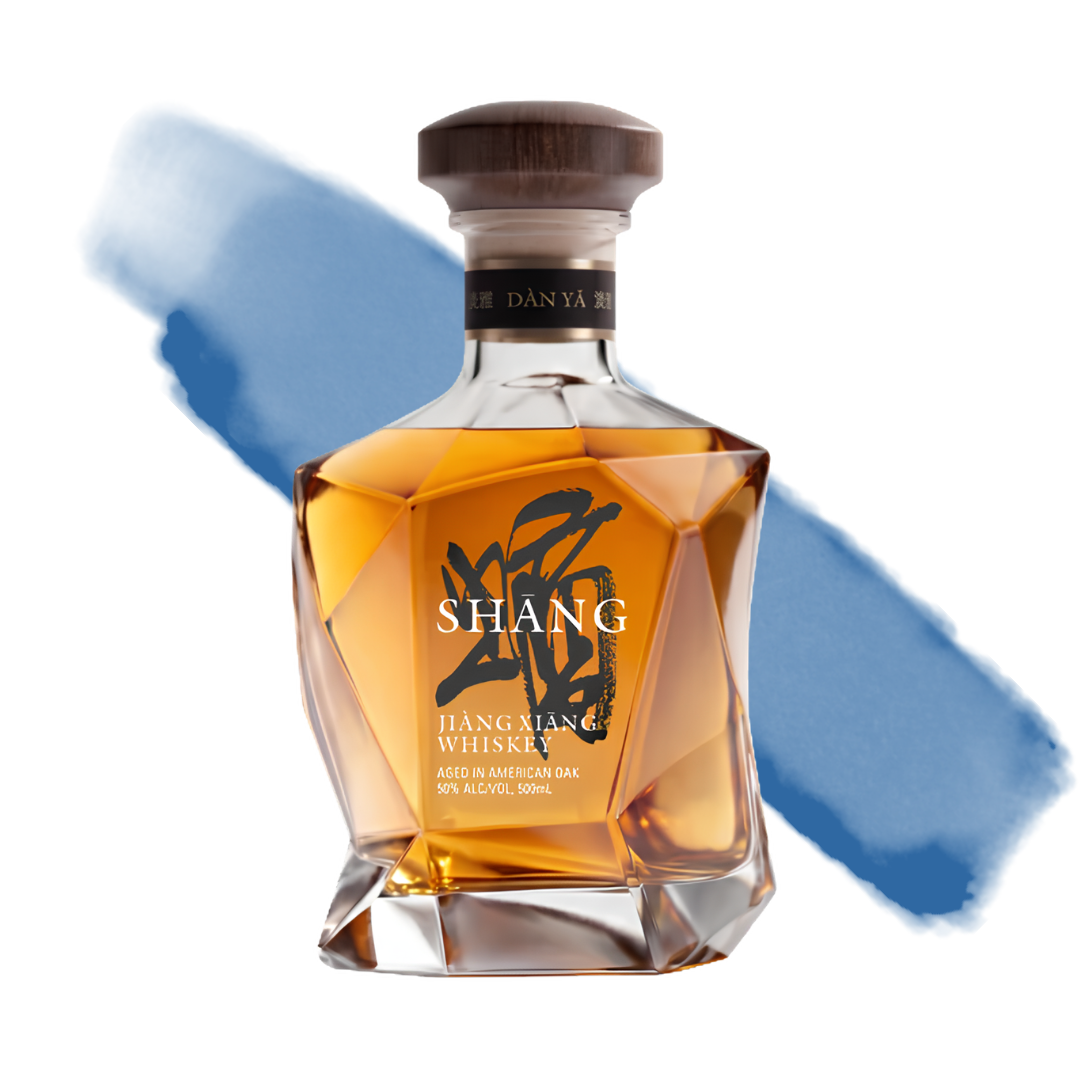
The short answer: SHĀNG Dàn Yǎ is a 100-proof, red-sorghum baijiu whiskey matured in charred American oak for one month to just under a year. A 500 mL bottle costs $64.99. Its floral, citrus, medicinal, and savory profile divided us sharply. Our combined score is 26.25/50, making this a curiosity to sample, not a blind buy.
Introduction
SHĀNG Dàn Yǎ, pronounced “dahn-yah,” is not a bourbon, Scotch, or conventional American craft whiskey. It is the first expression in a new international spirits line combining Chinese jiàngxiāng baijiu production with American whiskey-making techniques.
The process begins with red sorghum grown in China’s Chìshuǐ River basin. The grain undergoes solid-state fermentation before being distilled and aged in traditional clay vessels as sauce-aroma baijiu. That spirit is then redistilled into a whiskey base, transported to Kentucky, and matured in charred American oak barrels for at least one month and no longer than just under one year. SHĀNG describes the resulting category as “jiàngxiāng whiskey” or “baijiu whiskey.”
Dàn Yǎ is bottled at 100 proof, or 50% alcohol by volume. The brand has not published a conventional multi-grain mash bill, but red sorghum forms the foundation of the spirit. A 500 mL bottle carries a suggested retail price of $64.99, while a 50 mL bottle is available for $15.99.
Neither of us had tasted baijiu before this review, which created an unusual challenge. We had no established reference point for deciding whether Dàn Yǎ was representative of its source category. We could only evaluate how it performed in the glass and how likely it was to appeal to whiskey drinkers accustomed to bourbon, Scotch, or other Western styles.
That produced one of the widest disagreements we have had during a Film & Whiskey review. Let’s get into it.
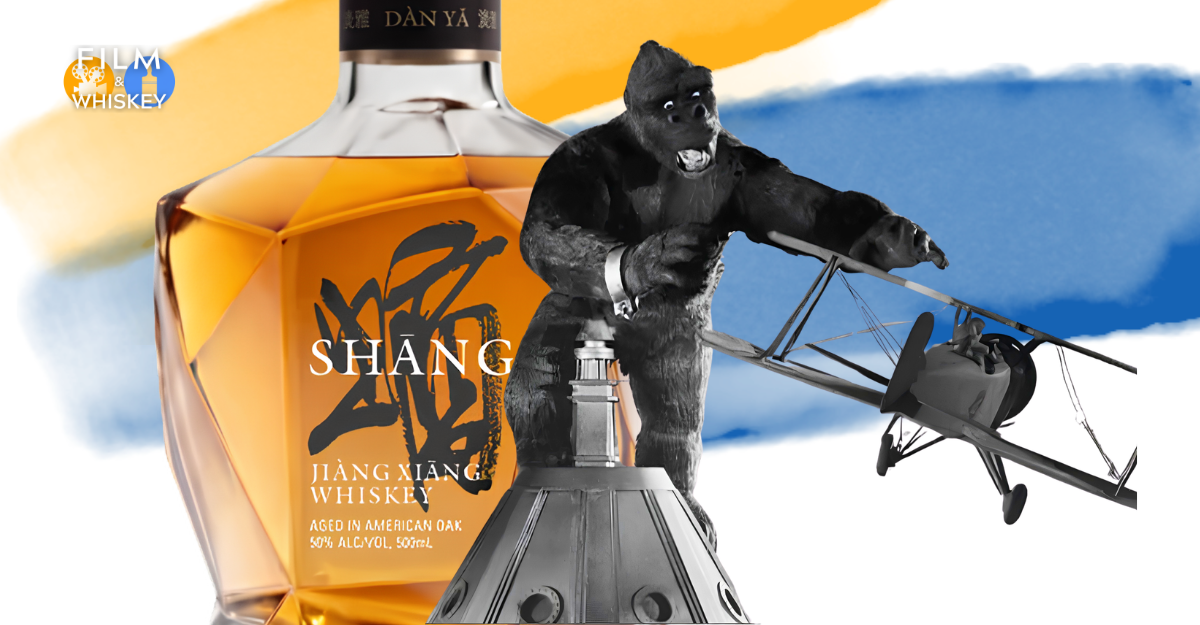
Today's review is taken from our podcast episode "King Kong (1933) / Shang Dan Ya Whiskey." Click the link to listen to this review in audio format.
Nose
Bob: I expected this to smell like soy sauce, and to my surprise, it doesn’t. It smells more like a young American craft whiskey cut with a higher-peat Scotch. Imagine taking one of the funkier craft whiskeys we’ve had on the show and adding a dropper of Ardbeg.
I’m not getting an intensely saline or umami character. There is an interesting floral note on top, along with something resembling seawater, but this is more approachable than I expected.
If I work at it, I can pick up some fishiness, but I have to think “fish” and dig my nose into the glass to find it. I’m sensitive to those aromas, so I’m glad they aren’t dominating my experience. I’m intrigued. 7.5/10
Brad: I have never had a nose change this much within a single smell. It moved from an apricot-jam sweetness into something resembling bandages, fish, or rotten food.
My body had a visceral reaction. I got the tingles and wanted to move the glass away from me. I think there is a difference between faulty distillate and a spirit whose flavor profile does not appeal to me. Nothing here makes me think they mishandled the distillation process. This is not for me. 3/10
Taste
Brad: The first flavor I found was peach jam. That moved into an almost-rotten apple, followed by seltzer water and saline.
The fishiness from the nose became more like decomposing apple on the palate. The taste is better than the aroma, but not by much. I am not enjoying this whiskey. 4/10
Bob: This has a strange progression. I’m with you on the fruit, but for me it is citrus rather than peach. I get heavy lemon, lemon peel, and vanilla at the front of my tongue.
As it moves toward the back of my palate, it starts tasting like a young Scotch. That does not surprise me because many Asian distillation traditions follow processes closer to Scotch or Irish whiskey production. We are dealing with sorghum here, but some of that character still feels familiar.
Then, out of nowhere, it's like someone lights a fuse down the center of my tongue. An intensely bitter flavor travels toward the back. I wouldn't call it rotten, and I’m not finding the dead or decaying flavors Brad describes, but it is medicinal.
It reminds me of an uncoated aspirin tablet dissolving on the tongue. Scotch drinkers may be more open to what this is doing, although even Scotch rarely delivers this exact type of medicinal bitterness. It is not something I would immediately reach for on a hot summer day, but we have also never reviewed a Chinese-made whiskey before. I don’t consider it a failed example of whiskey simply because it falls outside my preferred profile. 6.5/10
Finish
Brad: The finish returns to the fishy character. It reminds me of walking through the seafood section of a large public market. Most of the area smells like fresh fish, but then you pass a bucket of leftover brine and scraps.
That fish-market brine is what I taste here. There is some boiled pear underneath it, but the finish does not last long. 3.5/10
Bob: I am not having that experience. The most significant criticism I can make is that the whiskey tastes young. I wonder what this spirit would become if it were allowed to mature for four years. More time in the barrel might round off the bitterness and bring its vanilla notes forward.
On the back of my palate, I find apple peel and something that reminds me of tequila. I’m not a major tequila drinker, especially when drinking it neat. Unaged or lightly aged agave spirits can leave an herbal, bitter flavor behind, and that is what this finish evokes.
I am not claiming that I taste agave in the whiskey. It is closer to the aftertaste I associate with tequila. The result is fine, though I suspect additional maturation would improve it. 6/10
Balance
Bob: This is a completely new category for me, so I may be grading it on a curve or approaching it less harshly than I would a familiar style. I don’t want to pretend that I understand baijiu well enough to declare whether this is a strong or weak representation of it.
Evaluated as whiskey, Dàn Yǎ is an interesting experiment. At this stage, I don’t know whether I would call it more than that. The floral opening, citrus, vanilla, medicinal bitterness, and herbal finish create a coherent progression, but the whiskey’s youth keeps those elements from coming together as smoothly as they might with more time. 6/10
Brad: Bob’s tequila comparison reminded me of a tasting I attended in New Mexico. We tried pechuga mezcal, a style traditionally distilled with meat or other ingredients suspended above the still so their character becomes part of the final spirit.
This whiskey reminds me of that experience. I dislike the profile, but I also think the producers achieved what they intended. Because I find it so unpleasant, I have to keep the score low. Still, balance is my highest score among the four tasting categories. 5/10
Value
Brad: From a personal consumer standpoint, I cannot imagine spending $65 on a bottle for myself. However, what the producers are doing is fascinating. They are taking a spirit made on the other side of the world, redistilling it into whiskey, shipping it across the globe, and aging it in American oak. If someone described that production process without telling me the price, I might expect the bottle to cost $80 to $100.
At $65, the price is probably fair and reflects the work involved. I have to balance that production value against my belief that many American whiskey drinkers will dislike the flavor. Drinkers who primarily enjoy bourbon may have an even harder time with it.
I understand why it costs what it does. I don’t understand how large the audience for it will be. 3.5/10
Bob: I also wonder about the market. This feels like an experiment designed for a small group of American consumers who already know what baijiu is, along with people who have enough disposable income to pour an unusual spirit for guests.
It may also be created with the Chinese market in mind. American whiskey companies have long viewed China as a major opportunity, but SHĀNG is approaching that audience in a way other producers have not. Under those circumstances, the claim that this represents a new category makes more sense. They are not attempting to sell conventional Kentucky whiskey in China. They are building a spirit around traditions from both places.
Baijiu sold by American online retailers often begins around $39. If this is a respectable baijiu that has been redistilled, transported to Kentucky, and matured at Whiskey House of Kentucky, $64.99 seems fair.
That does not mean it reaches the upper echelon for me as a drinking experience. It means the price is defensible based on the spirit’s category and production process. 7.5/10
Final Scores
Brad: My final score is 19/50.
I am approaching this primarily as a consumer. If I were judging it solely as a whiskey critic, I might be closer to Bob’s score. The difficulty is that I do not know what to compare it to.
This does feel like a new whiskey category. It tastes unlike anything we have reviewed. Giving it an extremely high or low critical judgment feels incomplete because I have never tasted baijiu and cannot evaluate how well it represents that tradition.
I will disqualify any broader judgment and keep my conclusion personal: I think this tastes nasty. I do not like it.
Bob: My final score is 33.5/50.
That puts me below our 35-point recommendation line, but I still think Dàn Yǎ is worth sampling as an experiment. If you and a friend are interested in whiskey and want to experience a spirit derived from a country that is not commonly associated with whiskey production, the 50 mL bottle offers a manageable way to begin.
There is an important distinction between tasting this during a guided visit to Whiskey House of Kentucky and finding it on a retail shelf. At a distillery, hearing the production story while tasting the whiskey would create an exciting experience. Standing in a liquor store and deciding between this and another $65 bottle is different.
The story is compelling, but the average consumer may not connect with the narrative strongly enough to overcome the challenging flavors.
Combined Film & Whiskey score: 26.25/50
Conclusion
SHĀNG Dàn Yǎ is one of the most distinctive spirits we have reviewed, and the 14.5-point gap between our scores reflects how polarizing it can be. Bob found a young but intriguing combination of floral aromas, citrus, vanilla, medicinal bitterness, and tequila-like herbs. Brad encountered rotten fruit, fish-market brine, and flavors he had no desire to revisit.
On our scale, 35/50 is where we typically begin recommending that readers try a pour at a bar or consider buying a bottle. A score of 40/50 is great, while 45/50 is excellent. At 26.25/50, SHĀNG Dàn Yǎ falls below our normal recommendation range.
We wouldn't recommend buying the full 500 mL bottle blindly, especially for drinkers whose preferences begin and end with bourbon. However, adventurous whiskey fans, baijiu drinkers, and spirits enthusiasts interested in cross-cultural experimentation may find it worth trying once. The $15.99 miniature is the safest route.
Dàn Yǎ may not have won us over, but it did support the brand’s central claim: this does not taste like another variation on familiar American whiskey. It is attempting to create something new. Whether that new category has a broad audience remains an open question.
Frequently Asked Questions
Is SHĀNG Dàn Yǎ worth the price?
SHĀNG Dàn Yǎ is worth $64.99 only for adventurous drinkers interested in baijiu or experimental world whiskey. Our 26.25/50 combined score falls below our 35-point recommendation line. Most bourbon drinkers should avoid a blind purchase and consider the $15.99, 50 mL bottle before committing to the full 500 mL format.
What does SHĀNG Dàn Yǎ taste like?
SHĀNG Dàn Yǎ moves through floral fruit, citrus peel, vanilla, saline, medicinal bitterness, young Scotch-like grain, and herbal notes. Bob found it unusual but approachable, while Brad experienced fish-market brine, rotten apple, and a sharper savory funk. The shared conclusion is that it tastes unlike conventional bourbon, Scotch, or American craft whiskey.
How is SHĀNG Dàn Yǎ made?
SHĀNG Dàn Yǎ begins with red sorghum from China’s Chìshuǐ River basin. The grain undergoes solid-state fermentation and traditional baijiu production, including clay-pot aging, before the spirit is redistilled into a whiskey base. It is then matured in charred American oak in Kentucky for one month to just under one year.

Host
Bob grew up watching movies of all kinds, mostly with his dad. In high school, he became a fully-fledged film nerd, making and watching films regularly. He's since cooled it on his dreams to be Spielberg, and instead loves to teach about and discuss film with anyone who will listen.
Whiskey Review: Bardstown Bourbon Company Victoria Pineapple Finish