Whiskey Review: New Liberty Bloody Butcher 100% PA Bourbon
Introduction
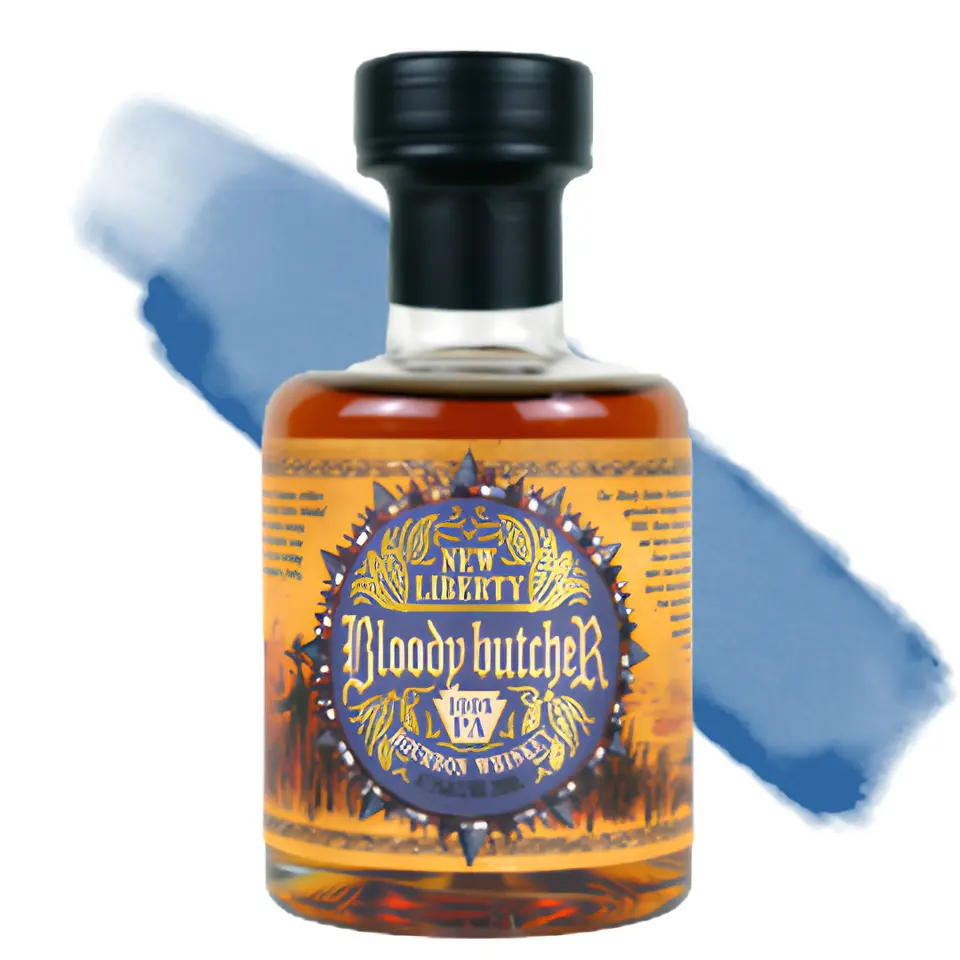
We’re checking out New Liberty Bloody Butcher 100% PA Bourbon Whiskey, one of several releases from New Liberty built around specific corn varietals.
Bloody Butcher is an heirloom corn, and New Liberty has used it across several expressions, including a straight bourbon, a Bordeaux cask-finished version, and a cask-strength release. The bottle we’re reviewing here is the original Bloody Butcher 100% PA Bourbon, which comes in an unusual 200 ml format.
The headline detail is the age: this whiskey has been aged for just one year.
That immediately raised some concern for us. Very young craft whiskey can be rough, grainy, and dominated by the sort of “craft funk” we’ve run into plenty of times before. But there’s also something genuinely interesting about what New Liberty is attempting here. The whiskey is bottled at 95 proof, with a mash bill of 70% Bloody Butcher corn, 26% rye, and 4% malted barley. Even the wood used for the barrels is sourced from Pennsylvania.
So the question wasn’t whether this was going to drink like a mature six- or eight-year bourbon. It clearly wasn’t. The more interesting question was how much character New Liberty could coax out of a one-year-old whiskey, and whether that distinctive corn varietal could give it something worth paying attention to.
This review is taken from our episode "Cape Fear (1962) / New Liberty Bloody Butcher 100% PA Bourbon." Click the link to listen to or watch this review in audiovisual format.
Nose
Brad: As I was pouring it, I immediately thought, “That’s a young whiskey.” It is very grain-forward. It has a lot of that craft funk that we’ve talked about.
To me, it reminds me a little bit of balsa wood. There are some baking spices throughout, maybe a hint of vanilla. There’s nothing offensive about this nose, but there’s also not really anything that I’m getting excited about.
5.5/10
Bob: This is always the hard part about scoring whiskey: are we judging it against the totality of whiskey, or are we judging it as a representative of what it is?
If you had stuck this in front of me blind, I think my score would be lower. But when you tell me this is craft whiskey and it’s a year old, I’m actually pretty impressed by it. We’ve had year-old whiskeys that are significantly harsher than this.
I’m surprised at how much well-rounded vanilla and baking spice I get. It absolutely has the young-grain smell and that craft-whiskey funk Brad mentioned, but they’re a little more tempered here.
Do I think this is an amazing nose when you’re talking about the whole world of whiskey? I don’t. But I’m pretty impressed with what they’ve done within this category.
7/10
Taste
Brad: I absolutely believe you need to judge things within their own category. But they’re also putting this on the shelf for the average consumer to purchase next to everything else, so I have to consider the other things I could buy at the store.
On the palate, it gets a little darker. It reminds me of dark roast coffee. There are baking spices, a lot of corn, and the vanilla starts to come through a little bit, but it’s still very grain-forward. I like it. I think it’s decent. Against the totality of whiskey, though, it’s a 6/10.
Bob: I’m going to be at a 6/10 as well. It’s fall in Ohio. We grow a lot of corn, so there are corn mazes everywhere. There’s a farm we go to sometimes where they basically make a ball pit for kids out of loose kernels of corn. This reminds me of that.
There’s a dustiness or bloom on corn that you can smell when you’re walking through a corn maze or through a barn where they’re processing it. It has an earthiness to it, almost like dirt. The sweetness of the corn hasn’t taken over yet, so it’s a much earthier palate.
There are also only so many good things you can say about a one-year-old whiskey. If this were seven years old, I think you’d really be getting somewhere, because it’s different. Even knowing that it’s made from a different corn varietal, I can tell this is a different kind of bourbon than what I normally drink. There’s potential here. Right now, it’s a six.
Finish
Bob: I actually liked the finish more than the palate. It was really pleasant and not too short. The whiskey itself doesn’t have a ton of body, but the finish lasts longer than I expected, especially for something this young and relatively low in proof.
7/10
Brad: I’m at a 6/10, same as my palate score. It gets a little leathery for me. The corn turns into this buttery corn-on-the-cob vibe, and the baking spices are still there. But it’s still a young, young, young craft whiskey.
Balance
Brad: I think everything here is well crafted and well made. It’s just not well aged. That distinction matters. I don’t think the problem is what New Liberty has made; I think the problem is simply that it hasn’t had enough time yet. 6.5/10
Bob: I’m sticking a little higher across the board at 7/10. If you and I were doing a tasting competition where the category was “American whiskey aged less than two years,” and there was a flight of whiskeys in front of us, I actually think this is probably the best of that lineup.
There’s a ton of potential here, and I want to reward that a little bit. Of the year-old bourbons we’ve had on this podcast, I can’t think of one that’s better than this. Do I wish it was five years old? Absolutely. But for what it is, it’s pretty good, man.
Brad: That was my takeaway too. I walked away thinking, “That’s pretty good.” It just needs another three to five years in the barrel. Once you do that, I think this could be an excellent bourbon.
Value
The version we reviewed comes in a 200 ml bottle for $20, which creates a strange value proposition. On a pure volume basis, that works out to roughly $75 for 750 ml, but buying a $20 specialty bottle is not necessarily the same thing as buying a $75 full-size bourbon.
Brad: Somewhere in that weird concoction of algebra and magic, I don’t find myself in a very positive spot on value. I’m not going to judge it as if it’s a $75 bottle, because it isn’t. It’s a $20 bottle. But it’s also a $20 bottle where you’re only getting 200 ml.
If you’re going to spend $20 on a specialty small bottle, you could go buy a full bottle of Rebel 100 for $20, and it’s going to be better than this by a wide margin. 4/10
Bob: I’m going to give it a 5/10. There’s a certain expectation here that reminds me of going to a farmer’s market. Am I going to pay 20 percent more for a jar of jam than I would at the grocery store? Yep. That’s part of the experience.
I think this is a “we visited your distillery and want to take a bottle home” whiskey. Everything is made in Pennsylvania, including the wood from the barrels. There’s something appealing about that everything-under-one-roof experiment.
If they were selling this in 750s and asking $75, I’d feel differently. But spending $20 on this little bottle, sharing it with a friend, and having a fun night with something unusual? I understand that.
Final Scores
Bob: 32/50
Brad: 28/50
Average Score: 30/50
The score lands below our usual recommendation threshold, but this is one of those cases where the number needs some context.
Bob: I think there’s a ceiling on what a one-year whiskey can be, and this is pretty much approaching that. That’s about the highest compliment I can give it right now. Give us a five-year version of this, because I would really like to try it.
Brad: Just age it a little longer and you’re going to have a really good product, I think.
At Film & Whiskey, 35/50 is generally where we begin recommending that you try a pour at a bar or consider buying a bottle. A whiskey that reaches 40/50 is great, while 45/50 is excellent territory.
At 30/50, New Liberty Bloody Butcher 100% PA Bourbon doesn’t quite get there in its current form. But neither of us walked away thinking New Liberty had made a bad whiskey. What stood out more was how much potential is already visible after only one year in the barrel.
Give this another three to five years, though, and we’d be very interested in coming back to it. That Bloody Butcher corn is doing something different. It just needs more time to finish the job.

Host
Bob grew up watching movies of all kinds, mostly with his dad. In high school, he became a fully-fledged film nerd, making and watching films regularly. He's since cooled it on his dreams to be Spielberg, and instead loves to teach about and discuss film with anyone who will listen.
Whiskey Review: Square 6 Wheated Bourbon